
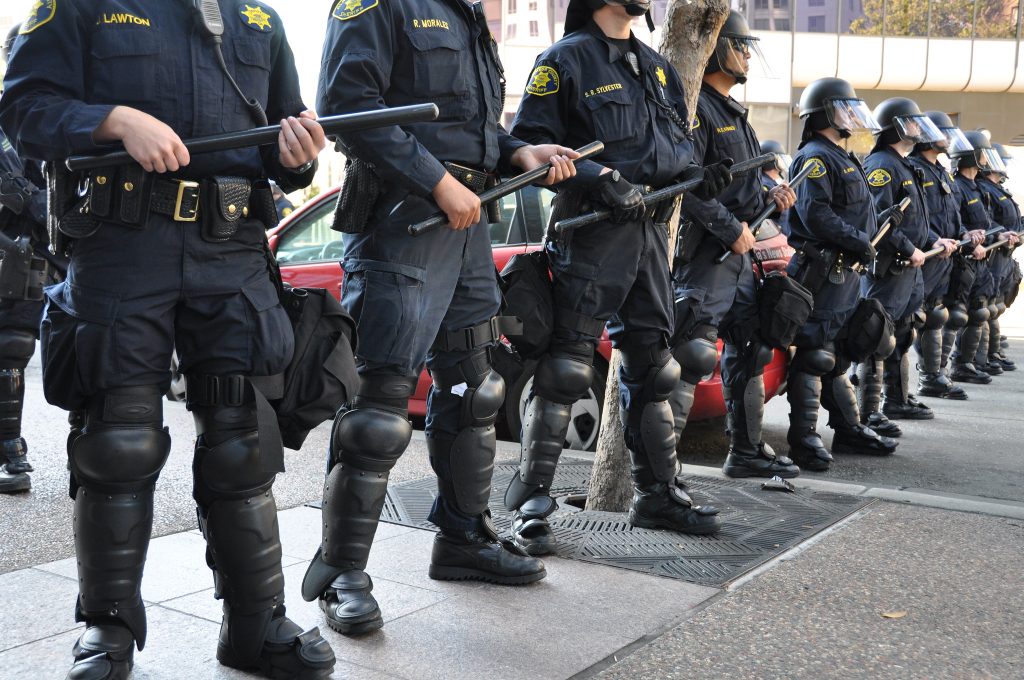
Following a civil society campaign led by the American Friends Service Committee (AFSC) and supported by Omega, the Sheriff’s Office in Alameda County, California, has withdrawn its Stingball grenades. However, a county vote on 17th November 2026 left deputies authorised to use 38mm rubber scattershot rounds against people.
Scattershot munitions release multiple kinetic impact projectiles at once. They include cartridges that fire multiple pellets or batons as well as grenades, such as Stingballs, that eject rubber balls when they burst. Omega considers scattershot munitions as unsuitable for law enforcement because they are inherently inaccurate and indiscriminate, and can cause permanent blindness, other serious injuries or death.
All types of kinetic impact ammunition can cause severe blunt force trauma or penetrating injuries at close range. For single-projectile ammunition, minimum firing distances are intended to reduce these risks. With scattershot munitions, however, increasing the distance introduces a further problem: the projectiles spread over a wider area, making it increasingly difficult to control who is struck and where. The inherent inaccuracy of multiple projectile ammunition, which is already present at shorter ranges, therefore worsens as the range increases. This can significantly increase the risk of striking vulnerable areas of the body or bystanders.
The consequences can be severe. A 2017 systematic review examined cases involving 1,984 people injured by kinetic impact projectiles. Head and neck impacts accounted for 49.1% of the deaths and 82.6% of the permanent disabilities recorded. Although the review covered kinetic impact projectiles generally, its findings show why the inability to avoid vulnerable areas of the body is so dangerous.
Training and minimum-distance rules cannot resolve this underlying design problem. An officer may aim the launcher accurately but cannot independently target each projectile.
The risks associated with scattershot munitions are recognised by international standards on the use of force. The United Nations Human Rights Guidance on Less-Lethal Weapons in Law Enforcement (2020), for example, states that kinetic impact projectiles should be accurate within a 10 cm diameter of the intended point of aim at the designated range, and that testing and authorisation must establish sufficient accuracy without excessive impact energy.
The UNODC/OHCHR Resource Book on the Use of Force and Firearms in Law Enforcement advises that weapons firing multiple projectiles simultaneously, or otherwise incapable of targeting a specific individual, should never be used because of the danger to bystanders.
In 2023, the UN Special Rapporteur on torture included ammunition containing multiple non-metallic KIPs in her Category A list of equipment she considers inherently cruel, inhuman or degrading and prohibited. Paragraph 53 specifically identifies its indiscriminate effects and significant danger to bystanders.
The campaign in Alameda County
Over the past few years, Omega has supported a campaign by AFSC to remove scattershot from law enforcement inventories in California. In Alameda County, residents challenged the weapons’ continued use under California’s Assembly Bill 481. The law requires agencies to report publicly on equipment classified as ‘military’, including certain weapons marketed as ‘less lethal’. Each year, the county’s elected Board of Supervisors must determine whether each type of equipment meets the standards for approval. These include findings that no reasonable alternative would achieve the same safety objective for officers and civilians, and that the use policy safeguards public welfare, safety, civil rights and civil liberties.
Earlier this year, the Alameda County The Sheriff’s Office reported holding 203 Stingball grenades, 340 multiple-projectile rubber baton rounds and 70 multiple-projectile wooden baton rounds. On 12th October it announced it would remove the Stingball grenades from its inventory.
Following this decision, AFSC organised public comments and urged supervisors to withdraw all three types. At AFSC’s invitation, Omega submitted written evidence to the county’s Public Protection Committee on 22th October. We argued that those who select and authorise these weapons share responsibility for the foreseeable harm they cause. On 28th October, we then joined AFSC and other CSOs and stakeholders for a follow-up meeting with staff from Supervisor Elisa Márquez’s office.
Following this engagement, the sheriff’s office further committed to not use wooden baton rounds against people and to revise its less lethal weapons policy to limit use against vulnerable people in all circumstances. The AFSC and Omega had also called for the withdrawal of the #6064 38mm rubber rounds from the inventory. However, At the November hearing, the Sheriff’s Office argued that deputies needed the rubber rounds as an alternative to lethal force. The Board agreed and voted 4–1 to accept the annual report, leaving the 340 rubber rounds authorised for use against people.
We urge the Board to revisit that decision at its 2027 review, publish a timetable for withdrawing the remaining rounds and prohibit future purchases and operational use of all scattershot munitions.
Other California counties and sheriff’s departments should use their next annual review to adopt the same prohibition, withdraw every scattershot munition they hold and publicly confirm when the last round has been taken out of service.